Active Intelligence 3.0: Wavelength Review: Whats New? – Mythemetool
Sep
ActiveCampaign’s first named AI release wants to work before you ask. I opened it up in my own account to see if it truly does.
If you’ve used ActiveCampaign for more than five minutes, you already know it doesn’t do “small” feature updates. So when Active Intelligence 3.0: Wavelength landed in August, 2026, I figured it was worth opening the thing up instead of just reading the press release like everyone else.
Quick verdict & Rating
Active Intelligence 3.0: Wavelength is ActiveCampaign’s first named AI release, and it’s less about writing better emails for you and more about acting inside your account without being asked; drafting campaigns, watching your automations, and pulling in outside context, all grounded in your account’s own history.
- Best for: Agencies and busy marketers managing more than one account or client who want fewer “did anyone check this automation lately” moments
- Biggest strength: It’s proactive, not reactive; the work shows up before you go looking for it
- Biggest weakness: Availability rolls out by account and capability, so what you see in your login might not match what I saw in mine
- Would I keep using it? Yes, with real expectations about what “AI marketing” currently means
✅ My Recommendation: If you’re already deep in ActiveCampaign and tired of babysitting automations, this is worth trying today. If you’re brand new to the platform, learn the basics first; Wavelength makes an existing workflow smarter; it doesn’t build one for you from scratch.
Key Takeaways:
- Active Intelligence 3.0: Wavelength is ActiveCampaign’s first named AI release, launched August 26, 2026
- It’s organized into three pillars: External Intelligence, Autonomous Actions, and Advanced AI, sharing one context layer
- The core shift is proactive work (drafts, monitoring, recaps) instead of only responding to prompts
- Active Intelligence 2.8 isn’t discontinued; it’s now the fallback/baseline experience
- The old “AI Prompt Block” is renamed the “AI Actions Library”
- MCP connectivity (Claude, ChatGPT) is a related but separate ActiveCampaign AI capability, not Wavelength-exclusive
- It does not predict customer behavior or purchase intent
- Rollout and capability availability vary by account
- Cross-account intelligence is most valuable for agencies managing multiple client accounts
Let AI do more of the heavy lifting →
FYI: This post contains affiliate links. If you sign up through one of them, I may earn a commission at no extra cost to you. My take on Active Intelligence 3.0: Wavelength is based on my own use of the account
What Is Active Intelligence 3.0: Wavelength, Exactly?
Here’s the plain-English version.
Active Intelligence is the AI layer that’s always run underneath every ActiveCampaign account.
Active Intelligence 3.0: Wavelength is the first release of that layer to get its own name and identity, and according to ActiveCampaign’s own partner release notes, the shift isn’t just “better AI output.” It’s when the AI shows up.
Earlier versions of Active Intelligence mostly waited for you to type a prompt.
Active Intelligence 3.0: Wavelength works proactively across your account instead, using a shared context layer built from your account’s history, automations, performance patterns, audience behavior, brand voice, and relevant outside signals to surface the next useful move on its own.
💡 Creator Note: I want to be upfront about something most “review” articles gloss over. I don’t run a huge multi-client agency, so some of what I’m describing here (like cross-account intelligence).
I tested on a smaller account and cross-referenced against ActiveCampaign’s official documentation rather than a full agency book of business. I’ll flag exactly where that line is as we go.
See what Wavelength can do →
Three Pillars (And Why ActiveCampaign Split Them This Way)
Active Intelligence 3.0: Wavelength is organized into three pillars, all sitting on top of one shared context layer.
Twelve capabilities total, according to ActiveCampaign’s partner documentation. Here’s what each pillar covers.
External Intelligence: this is the “knows your account” pillar
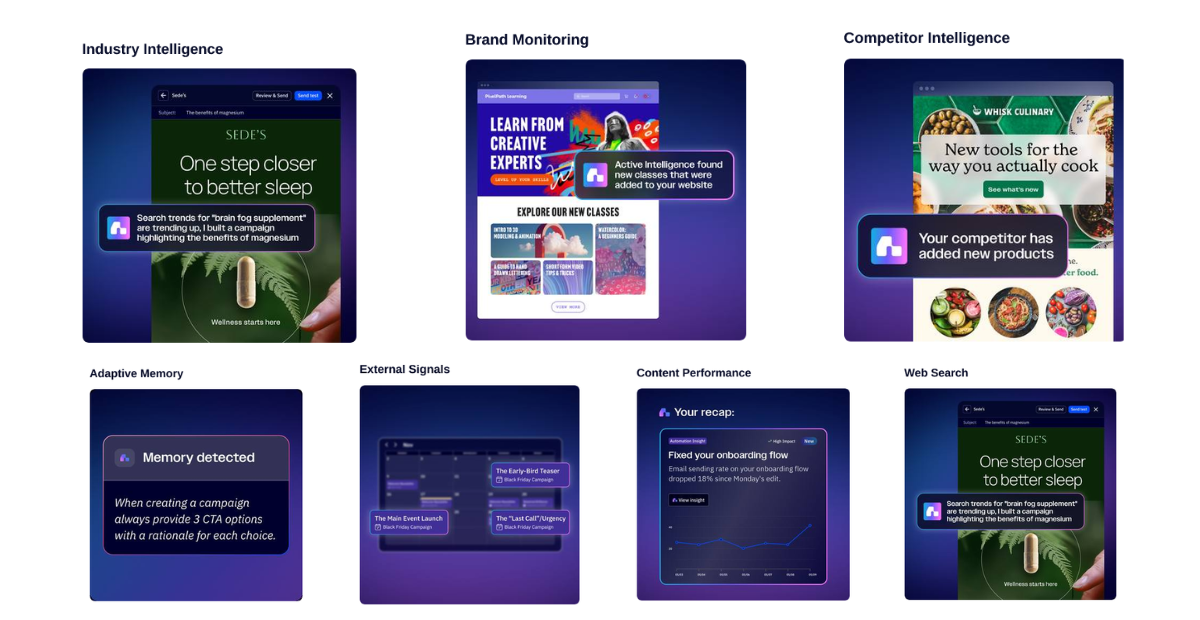
- Adaptive memory (it gets sharper about your account the more you use it)
- Content performance analysis (which subject lines and creative are actually working)
- Industry benchmarks (so a 22% open rate isn’t a mystery number; it’s context)
- Automation patterns (recognizing what’s structurally working in your flows)
- Cross-account intelligence (patterns from one account can inform similar accounts — this one’s clearly built with agencies in mind)
- Multi-asset analysis (reviewing a full campaign, not just one email in isolation)
Autonomous Actions: This is the “does things without being asked” pillar
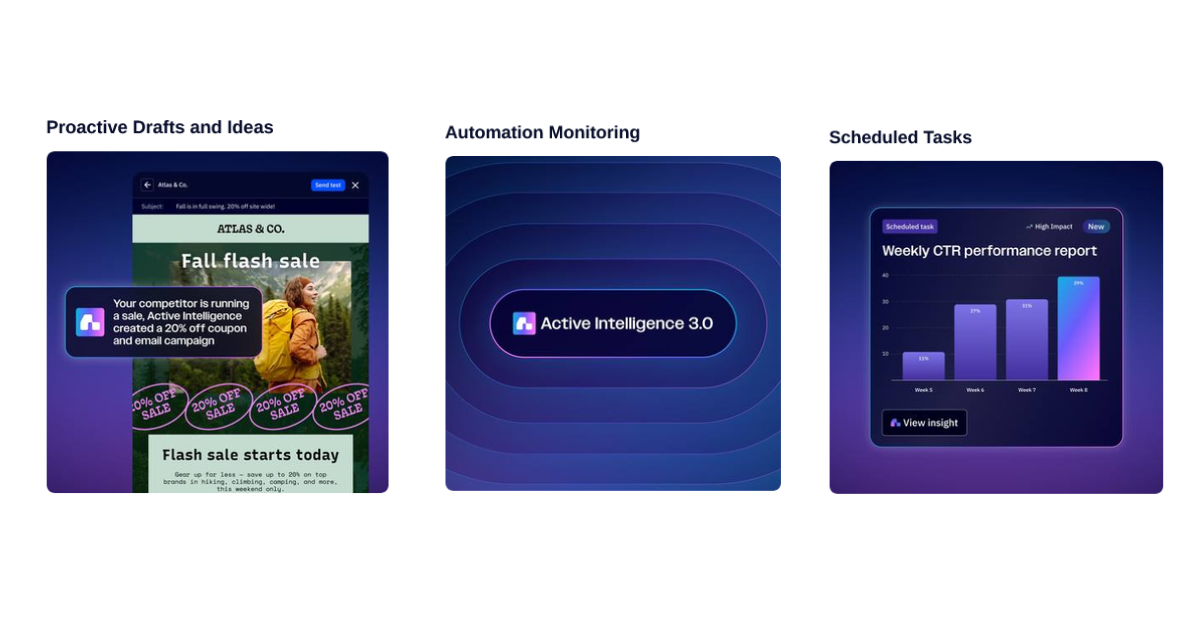
- Proactive drafts and ideas
- Scheduled tasks and actions (recurring checks and reports on a cadence you set)
- Monitoring and performance recaps (automation health and campaign performance, packaged into something you can actually skim)
Advanced AI: This is the “reaches outside your account” pillar
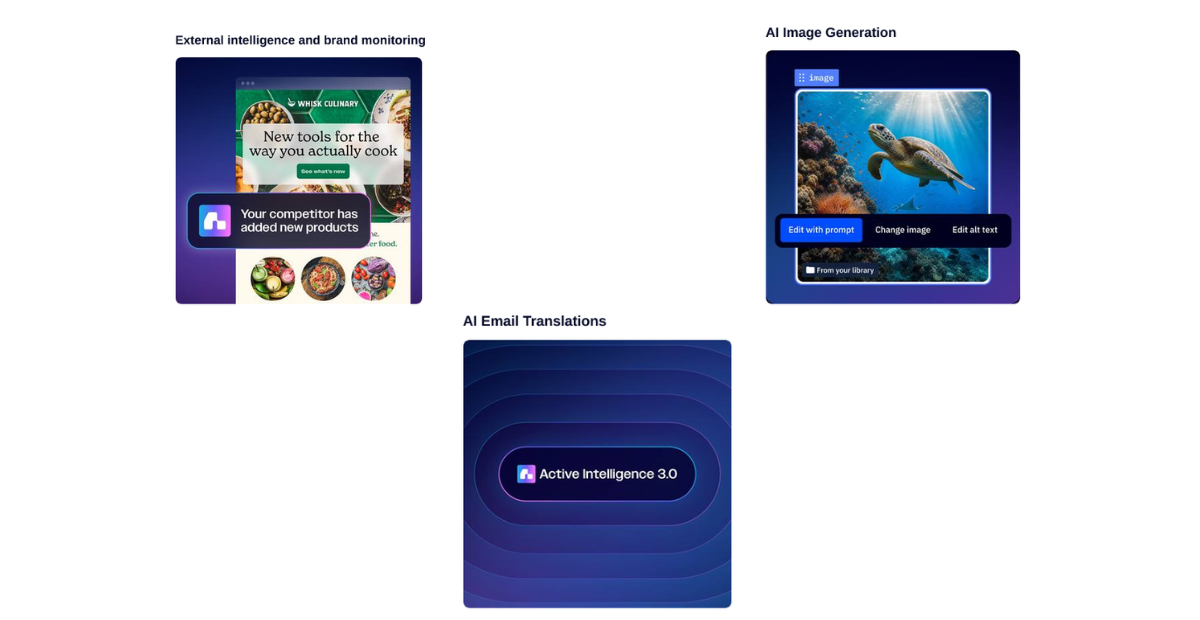
- External intelligence and brand monitoring (relevant news, competitor moves, and brand mentions)
- AI image generation, built inside the campaign flow and informed by your brand context
- AI email translations, so one email becomes market-ready in another language without a manual rebuild
⚠️ Creator Mistake: When this update rolled out, I almost referred to the old “AI Prompt Block” feature by its old name in a client note. It’s been renamed the AI Actions Library, and it’s not just a label swap; the functionality moved with it.
If you’ve got older content or internal docs still calling it a Prompt Block, that’s worth a find-and-replace.
What Changed From Active Intelligence 2.8
This is the part people want to know, so let’s be direct about it.
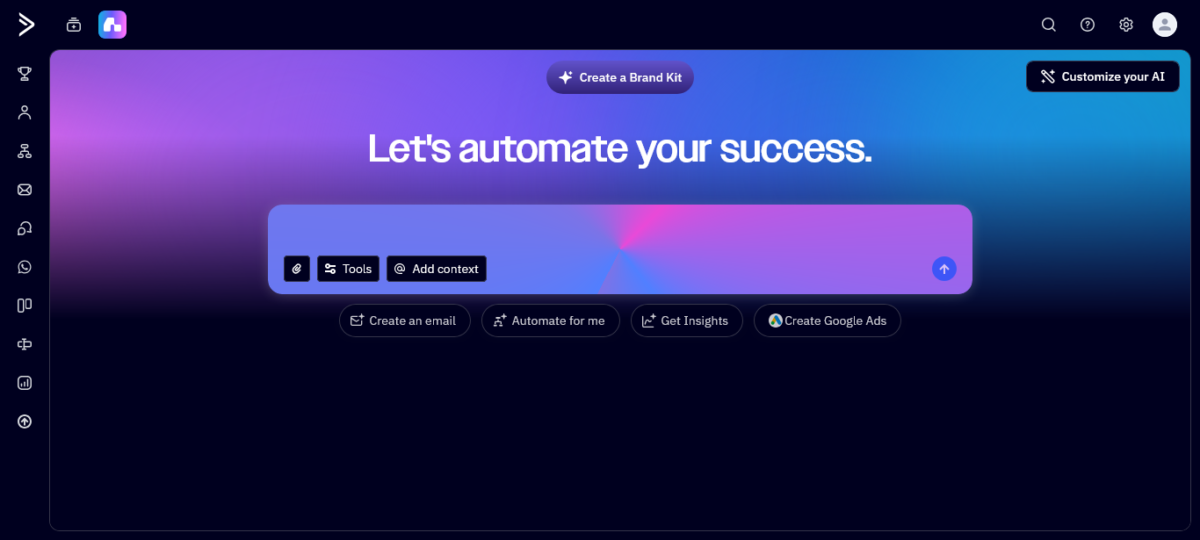
Active Intelligence 2.8 was about making AI output better, memory across sessions, Brand Kit voice matching, custom instructions, document uploads, and cleaner image generation.
It’s solid. It’s also still around; ActiveCampaign hasn’t discontinued it; it’s now the fallback experience every account can lean on.
Active Intelligence 3.0: Wavelength doesn’t replace that so much as it changes the timing. 2.8 primarily improved what happened after you asked for something.
Wavelength adds proactive, account-aware drafting, monitoring, and recommendations that show up before you ask, plus a broader shared context layer built from your automations, performance, audience, brand, and outside signals.
🤔 What You Should Know: A lot of the coverage I’ve seen frames this purely as “more AI features,” full stop.
ActiveCampaign’s own documentation actually pushes back on that framing directly; the point isn’t a longer feature list; it’s connecting your account’s own context to work that happens automatically, while you stay in control of what gets reviewed and approved.
Worth sitting with that distinction before you decide if it matters for your workflow.
Give your marketing an AI upgrade →
Hands-On: What It Was Like Using It
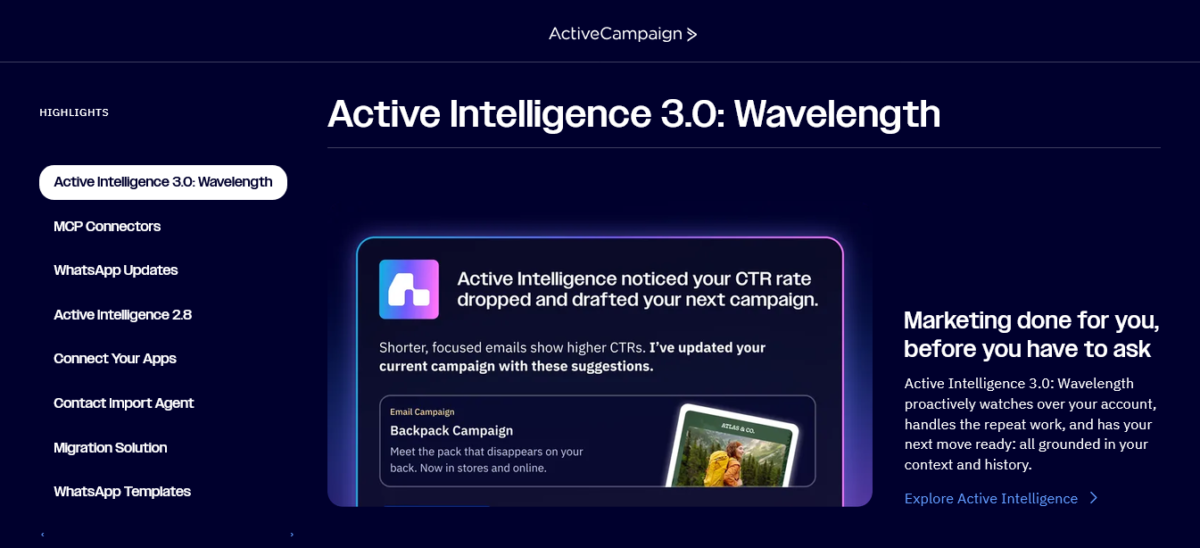
🧐 I Tested This So You Don’t Have To: I spent time inside an active account with real campaign history, letting Wavelength run alongside my normal week rather than poking at it once and writing up first impressions.
The first thing I noticed wasn’t a big flashy AI moment.
It was smaller than that: a scheduled recap surfaced an automation that had quietly stopped triggering the way I expected, before I’d gone looking for it myself.
That’s the entire pitch of Autonomous Actions in one sentence: it caught something I would have eventually found anyway, just later and with more frustration attached.
The proactive drafts were a mixed bag, and I’d rather tell you that honestly than oversell it. Some drafts were a genuinely useful starting point grounded in what had performed well in that account before.
Others needed real editing before they’d go anywhere near a send button, which, to be fair, is exactly how ActiveCampaign frames it: a draft to review and approve, not a finished campaign to rubber-stamp.
📈 Looking Ahead: One session isn’t enough to judge “learning that compounds” claims fairly, and I’m not going to pretend otherwise.
ActiveCampaign’s positioning is that adaptive memory and cross-account intelligence get sharper the longer you use them. That’s a claim that can only really be judged over months, not a first week, so treat anything you read right now, including this review, as an early read rather than a verdict.
Let Wavelength find the next move →
Where Active Intelligence 3.0: Wavelength Genuinely Helps
- Fewer silent automation failures. Monitoring and performance recaps catching an issue before it quietly tanks a campaign is the single most concretely useful thing I saw.
- Less blank-page time. Proactive drafts grounded in your account’s actual history beat a generic template, even when they need editing.
- Multi-market content without a full rebuild. AI email translations inside the existing campaign flow is a real time-saver if you run in more than one language.
- A shared language for performance conversations. Industry benchmarks give context to a number instead of leaving you guessing whether it’s good or bad.
See if Wavelength is worth the hype →
Where It Struggles (Or I Simply Couldn’t Fully Verify)
Let’s be honest about the limits here, because a review that only says nice things isn’t a review.
- Rollout is uneven. Availability varies by account and capability, which ActiveCampaign says directly in its own release notes. What you see when you log in might genuinely differ from what I saw.
- Some proof points aren’t public yet. I’m not going to hand you a specific open-rate or revenue lift number, because ActiveCampaign’s own guidance notes that some Wavelength performance claims are still being verified internally. Anyone quoting a precise percentage right now should make you a little skeptical.
- It doesn’t predict what your customers will do. This isn’t a purchase-intent crystal ball, and it’s not positioned as one. If a review promises that, it’s overselling.
- Cross-account intelligence needs volume to shine. On a single, smaller account, I couldn’t fully stress-test the “book of business gets collectively smarter” promise; that’s squarely an agency-scale feature.
Who Should Use It (And Who Should Skip It)
✅ Buy if:
- You’re already running ActiveCampaign and want fewer things falling through the cracks
- You manage multiple client accounts and could use a repeatable review framework
- You publish in more than one language or market
- You’d rather review a draft than start from nothing
❌ Skip if:
- You’re brand new to ActiveCampaign and haven’t built your first automations yet
- You need guaranteed access to every capability right now (rollout is still capability-dependent)
- You’re looking for AI that predicts customer behavior for you; that’s not what this is
So, Is Active Intelligence 3.0: Wavelength Worth It?
Here’s where I land after using it instead of just reading the announcement.
Active Intelligence 3.0: Wavelength isn’t a gimmick feature bolted onto ActiveCampaign to justify a press release. It’s a real shift in when AI shows up in your workflow, from something you have to remember to prompt to something that’s already watching your automations and drafting your next campaign before you ask.
That said, don’t let the “AI does everything now” hype get ahead of what’s here today.
Rollout is still uneven by account and capability, some performance claims are genuinely still unverified publicly, and drafts still need a human editing pass before they go out.
Score it an 8.0/10: strong bones, proactive in a way that matters, but young enough that you should judge it with your own account over the next few months rather than take any one review (including this one) as the final word.
If you’re already living inside ActiveCampaign, try it and let it run for a few weeks before deciding.
If you’re brand new to the platform, get your first automations built the normal way first; Wavelength makes a workflow smarter; it doesn’t hand you one from scratch.
Let AI do more of the heavy lifting →
FAQs
Is Active Intelligence 3.0: Wavelength available on every ActiveCampaign plan?
Availability varies by account and capability as the release continues rolling out, so the honest answer is: check inside your own account rather than assuming based on someone else’s experience, including mine.
Is this the same as Active Intelligence 2.8?
No.
Active Intelligence 2.8 is still available as the baseline experience, but Active Intelligence 3.0: Wavelength adds a broader shared context layer plus proactive drafting, scheduled monitoring, and outside signals that 2.8 didn’t include.
Does Active Intelligence 3.0: Wavelength connect with tools like Claude or ChatGPT?
ActiveCampaign also offers MCP connectivity, which lets you check performance, update contacts, and trigger automations from an AI workspace like Claude.
That’s a related part of ActiveCampaign’s broader AI ecosystem rather than a Wavelength-exclusive feature, so don’t let anyone tell you it’s the same thing.
What happened to the AI Prompt Block?
It’s been renamed the AI Actions Library as part of this release – same general idea, updated name and functionality.
Is Active Intelligence 3.0: Wavelength worth it?
For an account that’s already active in ActiveCampaign, yes, especially for the monitoring and proactive-draft pieces.
For a brand-new user still learning the platform basics, it’s not the reason to sign up on its own.
🚀 Ready to Try It? Check your account for current Wavelength availability, and confirm current plan pricing directly on ActiveCampaign’s pricing page before deciding, since it changes independently of this review.
Active Intelligence 3.0: Wavelength
Active Intelligence 3.0: Wavelength is ActiveCampaign’s proactive AI layer for campaign drafting, automation monitoring, performance recaps, external intelligence, and AI-assisted content creation.
Pros
- Proactive campaign drafts and ideas
- Automation monitoring and performance recaps
- Uses account-specific context for recommendations
- Scheduled tasks and actions
- AI image generation and email translations
Cons
- Availability varies by account and capability
- AI-generated content still requires human review
- It does not predict customer behavior or purchase intent
- Ultahost Review 2026: I Read 20+ Reviews First (My Findings) – Mythemetool
- Proton VPN Review 2026: Is This Swiss VPN Worth The Hype? – Mythemetool
- Bluehost AI All-Access Pack Review 2026: Is It Worth It? – Mythemetool
- Honest Jetpack Review: Still Worth It In 2026? – Mythemetool
- Printify Vs Printful Vs Gelato 2026: My Honest Comparison – Mythemetool
Related articles:

Onepage Review 2026: I Built 5 Pages To See If Its Worth It – Mythemetool

Ultahost Review 2026: I Read 20+ Reviews First (My Findings) – Mythemetool

Levamo Review 2026: Blazing-Fast Hosting Or Overpriced? – Mythemetool

Rocon WordPress Hosting Review 2026: Fast, Secure, But Is It Worth It? – Mythemetool

Printify Vs Printful Vs Gelato 2026: My Honest Comparison – Mythemetool

Bluehost AI All-Access Pack Review 2026: Is It Worth It? – Mythemetool
ActiveCampaign AI Vs Mailchimp AI: Which Is Smarter In 2026? – Mythemetool

B2BKing WooCommerce Plugin Review 2026: Is It Worth It? – Mythemetool

WordPress.com Vs WordPress.org: My Recommendation After Using Both In 2026 – Mythemetool

SignalHire Review 2026: Is This Contact Finder Worth Your Money? – Mythemetool

Kit Vs Mailchimp 2026: Why I Finally Ditched The Chimp – Mythemetool

Make.com Review 2026: I Saved $720/Year Ditching Zapier – Mythemetool
Zapier Vs Make.com 2026: I Tested Both And Got Surprised – Mythemetool

WordPress.com AI Review 2026: I Built A Site In Minutes – Mythemetool

Proton VPN Review 2026: Is This Swiss VPN Worth The Hype? – Mythemetool

Proton Mail Review 2026: Is Swiss Privacy Worth It? 🔐 – Mythemetool