ActiveCampaign AI Vs Mailchimp AI: Which Is Smarter In 2026? – Mythemetool

Jul
Two platforms. Two AI visions. One winner for your marketing stack.
My Quick Answer
In the ActiveCampaign AI vs Mailchimp AI comparison for 2026, ActiveCampaign AI (Active Intelligence) wins on automation depth, autonomous execution, deliverability, and CRM intelligence.
Its Active Intelligence engine includes 25+ specialized AI agents that build campaigns, generate multi-step automations, optimize send times per individual contact, and benchmark performance against billions of data points.
Mailchimp AI, powered by Intuit Assist, wins on accessibility, design-first AI tools, a generous feature set for beginners, and its brand-new Analytics AI agent launched in May 2026.
If you need AI that executes marketing strategy autonomously, ActiveCampaign wins. If you need AI that helps you create faster and understand your data more easily, Mailchimp competes seriously.
Read the full comparison below for category-by-category results.
📢 Affiliate Disclosure: This post contains affiliate links. If you sign up for ActiveCampaign or Mailchimp through links in this article, we may earn a commission at no extra cost to you. I tested both platforms independently.
Conversation That Started This Comparison

I was sitting at a co-working space last month, working through a client brief, when my phone lit up with a message from Chidi, a creator friend of mine based in Lagos. He’d been on Mailchimp for two years, was considering switching to ActiveCampaign, and had one very direct question:
“Mia, forget the features list. Just tell me which one has smarter AI.”
I put the brief down. Because honestly, that is the right question for 2026. Both platforms have AI all over their marketing. Both use the word “intelligent” in press releases the way politicians use the word “transparency.” And both have made genuinely significant AI launches in the past 12 months.
But they are not building the same thing. And the difference matters enormously depending on what you’re actually trying to do with your marketing.
So this is the ActiveCampaign AI vs Mailchimp AI comparison I wish existed when I started testing both platforms. Category by category. Fact by fact. With my honest opinion at every step.
Let’s get into it.
Platform Context: Who Are These Tools For?
Before we compare AI features, you need to understand the philosophical difference between these two platforms. Because it shapes everything, including how they’ve each approached AI.
ActiveCampaign was built as a marketing automation and CRM platform. Its DNA is behavior-triggered customer journeys, deep personalization, sales and marketing integration, and complex conditional logic.
It serves over 180,000 businesses across 170+ countries and holds a 4.6/5 rating on Capterra from more than 13,000 reviews. It was named a Leader in the IDC MarketScape: Worldwide AI-Enabled Marketing Platforms for Small Businesses 2025.
Mailchimp, now owned by Intuit since 2021, was built as an accessible email marketing platform and has since evolved into a broader multi-channel marketing tool. It is trusted by over 17 million users worldwide, which is a staggering number.
It holds a 4.4/5 on G2 and integrates with 300+ platforms, including Shopify, WooCommerce, Wix, and QuickBooks. Its AI is powered by Intuit Assist, which draws on Intuit’s enormous financial and behavioral data network spanning QuickBooks, TurboTax, and Credit Karma users.
One is a specialist built for marketers who need automation precision. The other is an accessible platform built for businesses that want everything in one place without a steep learning curve.
That contrast is the key to understanding every AI comparison below.
Don’t wait, try ActiveCampaign Active Intelligence →
AI Engines: Active Intelligence vs Intuit Assist
ActiveCampaign AI: Active Intelligence
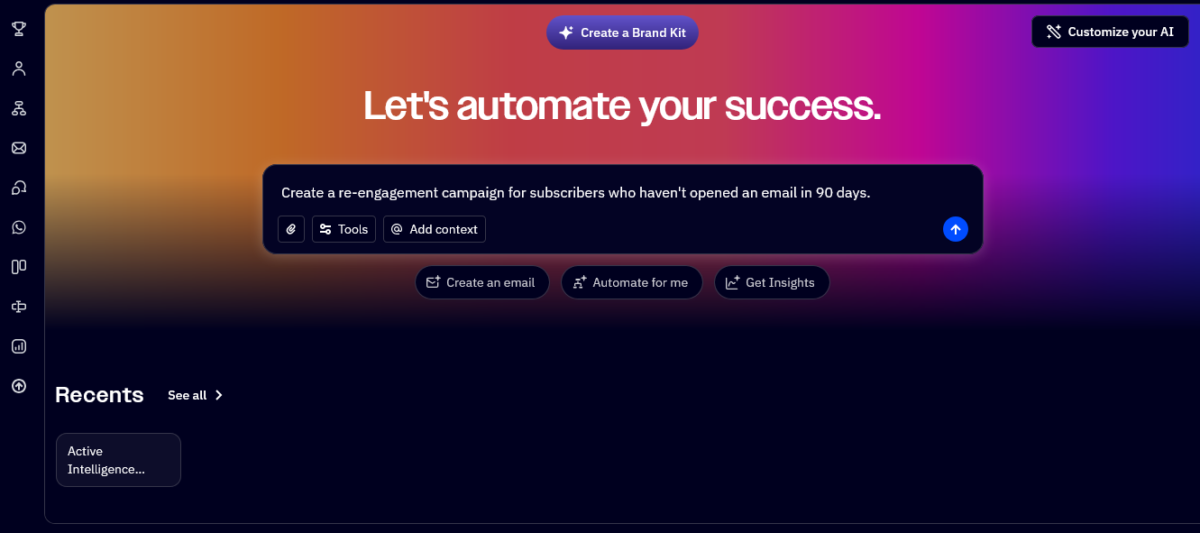
In May 2025, ActiveCampaign launched Active Intelligence, which it describes not as a feature update but as a complete reimagination of how marketing automation works.
By October 2025, it was live across all plan tiers, with partner accounts gaining simultaneous access.
The rollout wasn’t just fast. People actually used it.
Between July and November 2025, over 17,000 ActiveCampaign customers generated more than 59,000 AI interactions, helping Active Intelligence become the company’s fastest-growing feature area in two years. That’s a 77% adoption rate.
Active Intelligence operates through 25+ specialized AI agents working inside a conversational workspace. You describe what you want to achieve in plain language. The agents build the strategy, construct the workflows, optimize the timing, and analyze the results.
This is what the industry is starting to call autonomous marketing: you set the goal, the AI executes the plan.
See Active Intelligence in action →
Mailchimp AI: Intuit Assist + Analytics AI
Mailchimp has had AI features in production since 2022, when it generated over 8 million data-backed recommendations using tools like Send Time Optimization, Predictive Segmentation, and Product Recommendations.
Its current AI layer, Intuit Assist, went deeper with generative AI for email copy, design templates, and automation flows.
Then, on May 28, 2026, Mailchimp launched its most significant AI move yet: Analytics AI, a native conversational analytics agent built directly into the platform.
Analytics AI connects campaign performance, audience behavior, and revenue outcomes and lets marketers ask plain-language questions to get instant, strategic recommendations. No dashboards to build. No reports to export. Just answers.
Mailchimp also announced on the same date expanded integrations with Claude, Wix, and WooCommerce, allowing Mailchimp’s AI capabilities to operate inside platforms merchants already use daily.
This is a direct response to what ActiveCampaign did with its own Claude MCP connector in November 2025, and it’s a significant move.
Additionally, Mailchimp launched an AI Segment Builder (beta) at the same time, allowing marketers to describe their ideal audience in plain language and have AI automatically construct the segment using behavioral, demographic, and engagement data.
Mailchimp is no longer playing catch-up on AI. It’s competing seriously. Whether it’s competing at the same level is what we need to determine.
Round 1: AI Campaign Building
ActiveCampaign
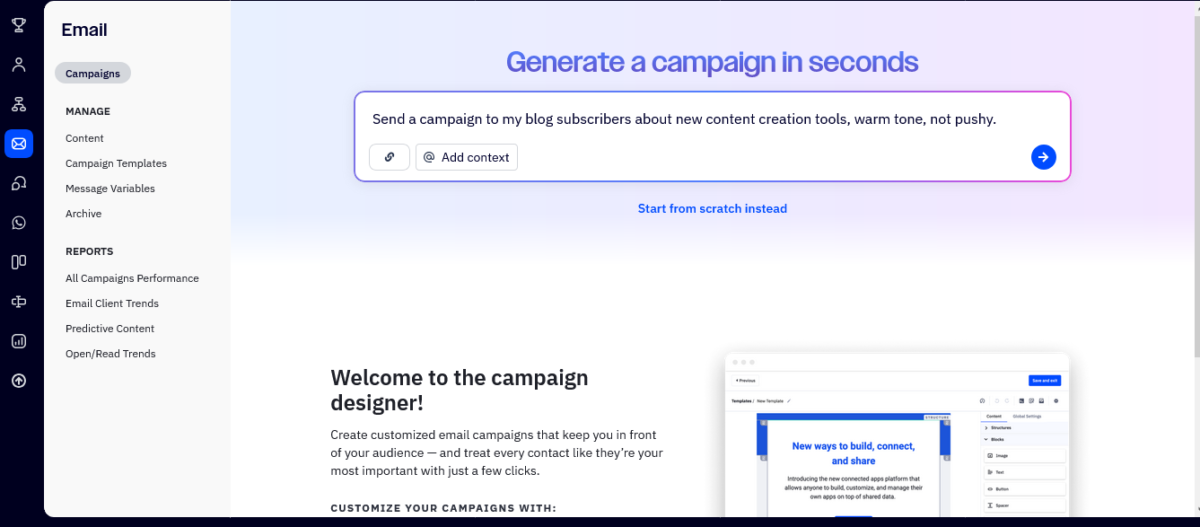
The AI Campaign Builder generates complete email campaigns from a simple text prompt. You describe your goal, the tone, and the audience. It produces subject lines, preview text, and full body copy structured and ready for review.
The Campaigns Agent handles this autonomously, and the AI Brand Kit applies your brand colors, fonts, and logo from your website URL automatically to every template it generates.
On the Pro plan and above, the AI Content Generator also adapts copy based on your contact’s segment and behavior history, so the campaign doesn’t just write itself; it personalizes itself.
Mailchimp
Mailchimp’s generative email builder can produce complete campaign drafts from a three-sentence brief, including imagery, copy, and call-to-action placement. The Creative Assistant imports your brand assets into a Brand Kit and uses them to auto-generate on-brand designs at scale.
The Content Optimizer then analyzes completed drafts for tone, readability, CTAs, link errors, and imagery best practices before you send.
According to Mailchimp’s 2025 benchmarking data, campaigns using AI-assisted send-time optimization showed a 29% improvement in open rates compared to manually scheduled campaigns.
The Magic Morph feature (added in 2025) allows teams to maintain visual consistency across hundreds of assets without manual restyling.
Round 1 Verdict
| Feature | ActiveCampaign AI | Mailchimp AI |
|---|---|---|
| Campaign Copy Generation | Yes (Campaigns Agent) | Yes (Intuit Assist + Write with AI) |
| Brand Kit Application | Yes (AI Brand Kit, all plans) | Yes (Creative Assistant, Standard+) |
| Content Quality Checking | Limited | Yes (Content Optimizer) |
| Image + Design Generation | Limited | Yes (Creative Assistant) |
| Campaign Personalization by Segment | Yes (Pro+) | Yes (Standard+) |
| Multi-channel Campaign Generation | Yes (email, SMS, WhatsApp) | Yes (email, SMS, social ads) |
Winner: Tie with advantages on each side. ActiveCampaign’s personalization and multi-channel execution are stronger. Mailchimp’s design tools, Creative Assistant, and Content Optimizer give it a meaningful edge for teams where visual consistency and design quality matter more than behavioral depth.
👉 Try ActiveCampaign AI free for 14 days. No card needed.
Round 2: AI Automation Building
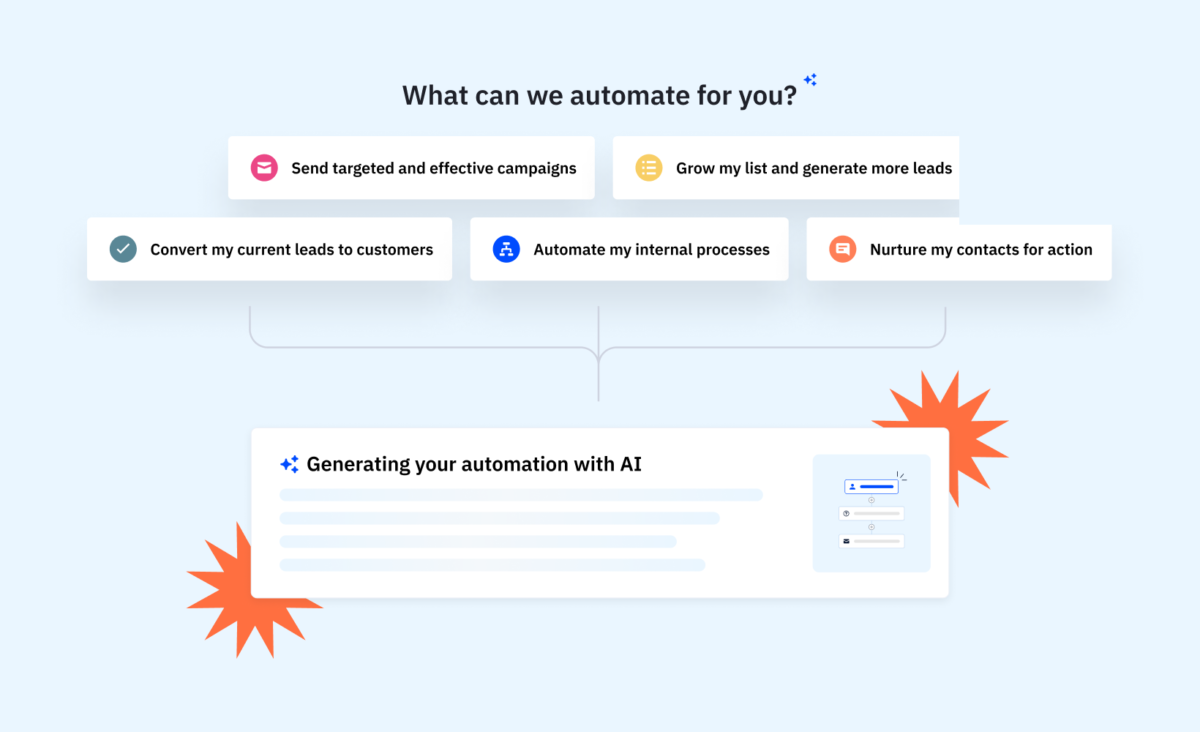
This is where the comparison becomes genuinely uneven. And I want to be fair about why.
ActiveCampaign
The AI Automations Agent is one of Active Intelligence’s most powerful tools. You describe a marketing goal in plain language, and it constructs a complete multi-step automation workflow. Conditional branches, wait steps, behavioral triggers, goal tracking, exit conditions.
The whole thing, built from a sentence.
On top of that, ActiveCampaign supports over 135 triggers and actions and 500+ pre-built automation recipes.
The automation logic handles if/then branching, lead scoring triggers, CRM deal stage changes, SMS and WhatsApp sequences, and custom event triggers. Complex, conditional, deeply behavioral automation is native to this platform.
Active Intelligence’s autonomy goes further: the system doesn’t just build automations; it monitors them, identifies underperformers through the AI Insights Agent, and suggests specific changes.
Mailchimp
Mailchimp’s automation platform, the Customer Journey Builder, is solid and visually clean. You get multi-step flows with branching logic, up to 200 journey points on Standard, and AI-generated automation flows that produce fully built emails for each step.
However, there are clear structural limitations. The free plan lost multi-step automation access entirely in June 2025 (now Essentials minimum required for anything beyond welcome emails). The Standard plan caps automations at 200 journey points.
There is no equivalent to ActiveCampaign’s AI Automations Agent that builds the entire workflow from a plain-language prompt. Mailchimp’s AI assists automation creation. ActiveCampaign’s AI autonomously constructs it.
Mailchimp positions agentic marketing as its future direction rather than a capability that’s fully available today.
In its May 2026 Analytics AI announcement, the company says Analytics AI “lays the foundation” for a fully connected, agentic marketing experience where AI plans strategy, builds audiences, drafts campaigns, and learns from results.
That vision is compelling, but Mailchimp has not yet released the complete end-to-end autonomous workflow it describes.
Round 2 Verdict
| Feature | ActiveCampaign AI | Mailchimp AI |
|---|---|---|
| AI Automation Builder (plain language) | Yes (Automations Agent, Pro+) | No (coming soon per May 2026 announcement) |
| Visual Automation Builder | Yes (135+ triggers/actions) | Yes (up to 200 journey points, Standard+) |
| Pre-built Automation Recipes | 500+ | 50+ |
| Conditional Branching Depth | Advanced (unlimited) | Moderate (200 journey point cap) |
| Lead Scoring Triggers | Yes (Plus+) | No |
| Multi-channel Automation (SMS, WhatsApp) | Yes (Pro+) | Yes (SMS, Standard+) |
| Free Plan Automation | 5-action limit | Welcome email only (June 2025 change) |
Winner: ActiveCampaign AI. The depth of automation logic and the existence of an actual AI agent that constructs workflows autonomously is a category difference, not a feature gap.
👉 Build your first AI automation in minutes. Start free.
Round 3: AI Send Time Optimization
ActiveCampaign
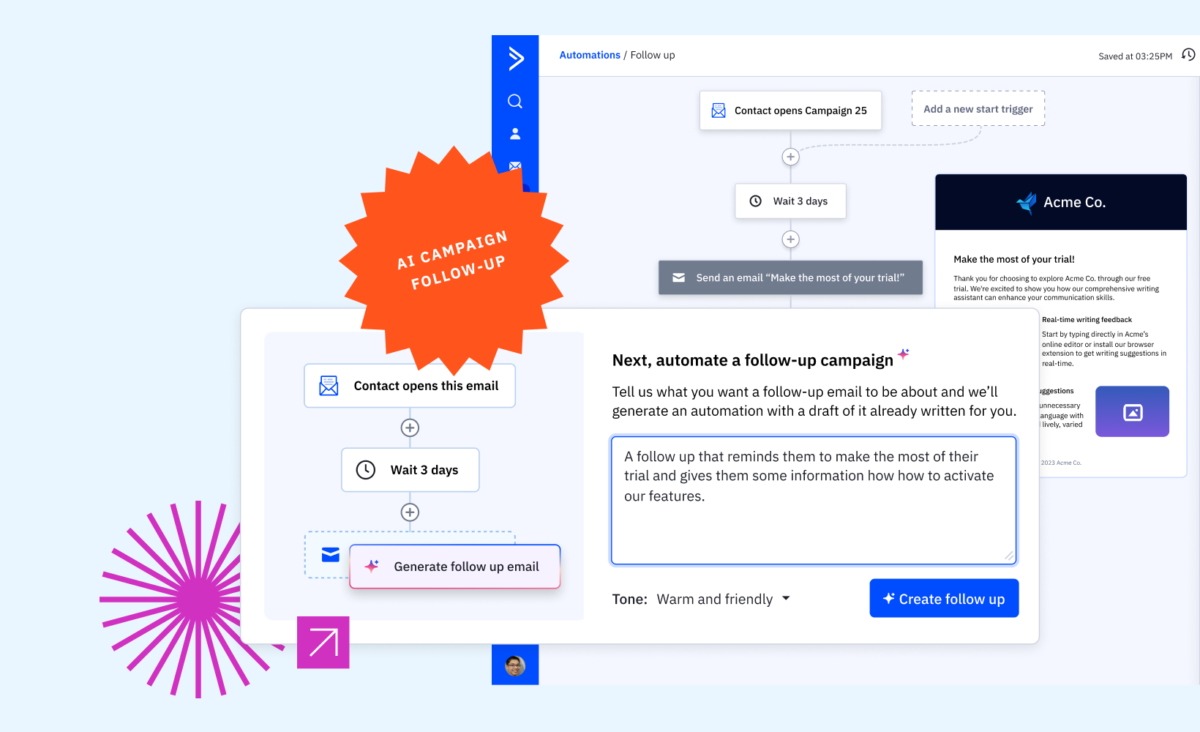
Predictive Sending analyzes each contact’s individual engagement history and delivers emails during their personal optimal open window within 24 hours of send.
The model recalculates every week, and 10% of sends are used to explore new time windows to stay current with evolving behavior patterns.
According to ActiveCampaign’s own data, Predictive Sending produces an average 17% increase in click-through rates.
Mailchimp
Mailchimp’s Send Time Optimization and Send Day Optimization analyze when your audience is most likely to engage and recommend the best delivery windows.
According to Mailchimp’s 2025 benchmarking data, campaigns using this feature showed a 29% improvement in open rates compared to manually scheduled campaigns.
It’s worth noting the difference in how these two stats are framed. ActiveCampaign reports a 17% improvement in click-through rates, which is a downstream conversion metric. Mailchimp reports a 29% improvement in open rates, which is a top-of-funnel metric.
Both numbers are from the companies’ own data. Independent comparison between these specific stats isn’t available. What matters is that both tools are meaningfully moving engagement metrics with AI timing optimization.
The key functional difference is that ActiveCampaign optimizes send time per individual contact. Mailchimp optimizes for your audience more broadly. Per-contact optimization is more sophisticated by definition because it accounts for individual variation rather than aggregate patterns.
Round 3 Verdict
| Feature | ActiveCampaign AI | Mailchimp AI |
|---|---|---|
| Per-contact send time optimization | Yes (Predictive Sending, Pro+) | No (audience-level optimization) |
| Audience-level send time optimization | Yes | Yes (Standard+) |
| Send day optimization | Yes | Yes (Standard+) |
| Reported improvement (company data) | 17% CTR lift | 29% open rate lift |
| Weekly model recalibration | Yes | Not specified |
Winner: ActiveCampaign AI on sophistication. Per-contact optimization is a meaningfully higher level of personalization than audience-level timing. That said, Mailchimp’s 29% open rate improvement is a real result and shouldn’t be dismissed.
Round 4: AI Analytics and Performance Intelligence
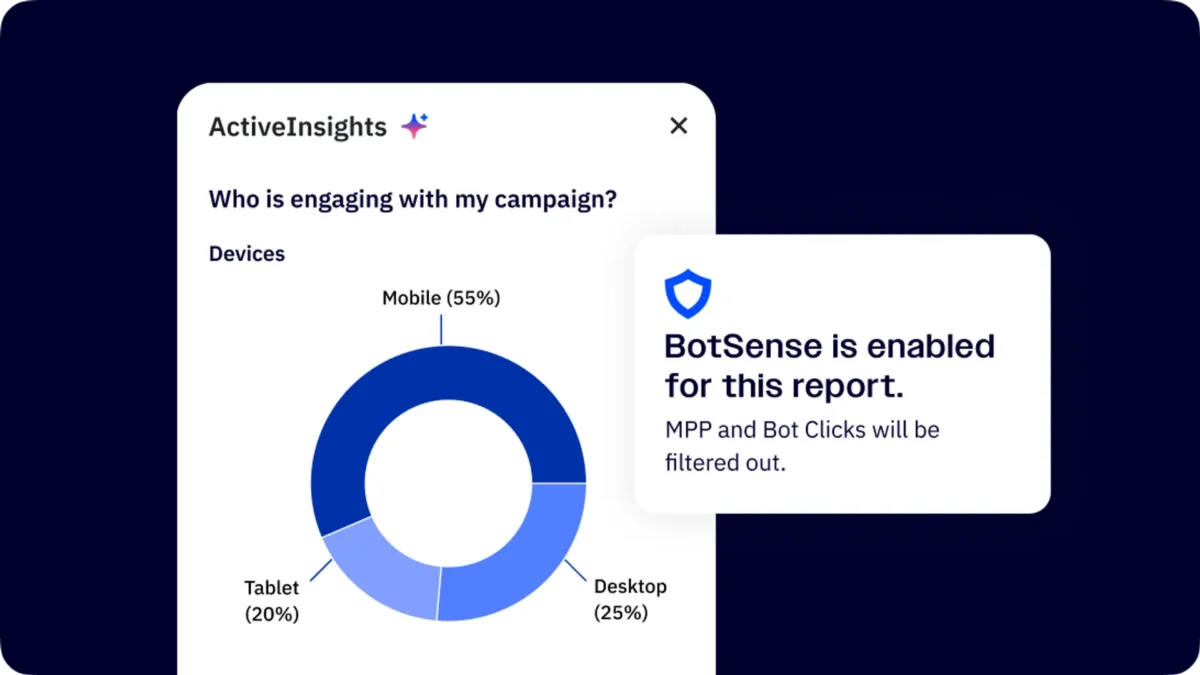
This is the round where Mailchimp’s May 2026 launch changes the game significantly.
ActiveCampaign
AI Performance Intelligence continuously analyzes campaign and automation performance against billions of signals across the ActiveCampaign platform.
It benchmarks your results against other campaigns in your specific sector and alerts you when performance is above or below your sector average. It pinpoints the specific creative, timing, and audience factors driving the difference.
The Campaign Reporting Co-Pilot answers plain-language performance questions inside the dashboard. The Insights Agent monitors live performance and surfaces specific optimization recommendations in real time.
Combined with the Claude MCP connector (launched November 2025), you can also ask your marketing data natural-language questions directly inside Claude, with the AI pulling live results from your ActiveCampaign account.
I wrote about it here: What Is MCP for WordPress Users? Complete Guide 2026
This was the first autonomous marketing connector in Anthropic’s Claude Connector Directory.
Mailchimp
Analytics AI launched May 28, 2026, and it is Mailchimp’s most significant AI move in the platform’s history. It is a native conversational analytics agent that connects performance across campaigns, audiences, and revenue to tell businesses what changed, why, and what to do next.
Unlike traditional dashboards requiring manual analysis and report exports, Analytics AI lets you ask plain-language questions and receive instant, strategic recommendations.
It uses each customer’s connected ecommerce data from Shopify, WooCommerce, and Wix alongside Mailchimp campaign history to identify patterns and surface opportunities that connect marketing activity directly to revenue impact.
Mailchimp also simultaneously announced a Claude integration and a WooCommerce integration, allowing site interactions like product views and cart additions to activate as marketing triggers with a single-click pixel installation.
The Claude integration means Mailchimp users can now access their marketing data conversationally inside Claude, the same capability ActiveCampaign launched 7 months earlier.
Additionally, the AI Segment Builder (beta) now allows marketers to describe their ideal audience in plain language and have AI automatically construct the segment from behavioral, demographic, and engagement data.
Round 4 Verdict
| Feature | ActiveCampaign AI | Mailchimp AI |
|---|---|---|
| AI Performance Intelligence | Yes (Pro+, sector benchmarking) | Analytics AI (May 2026, all paid plans) |
| Plain-language analytics querying | Yes (Reporting Co-Pilot) | Yes (Analytics AI) |
| Revenue-connected campaign analysis | Yes | Yes (Shopify, WooCommerce, Wix data) |
| Claude integration | Yes (MCP, Nov 2025, all plans) | Yes (integration, May 2026) |
| AI Segment Builder | Yes (Segments Agent) | Yes (beta, May 2026) |
| Sector/industry benchmarking | Yes (Performance Intelligence) | Not confirmed |
Winner: Tie in June 2026. ActiveCampaign had a meaningful head start. Mailchimp’s Analytics AI launch has closed the gap significantly, and in some areas, particularly the ecommerce data connections and the conversational revenue analysis, it matches or equals what ActiveCampaign offers.
This round is genuinely close now in ways it wasn’t six months ago.
👉 Get AI analytics that tell you what to do next. Try ActiveCampaign free.
Round 5: AI Deliverability and List Intelligence
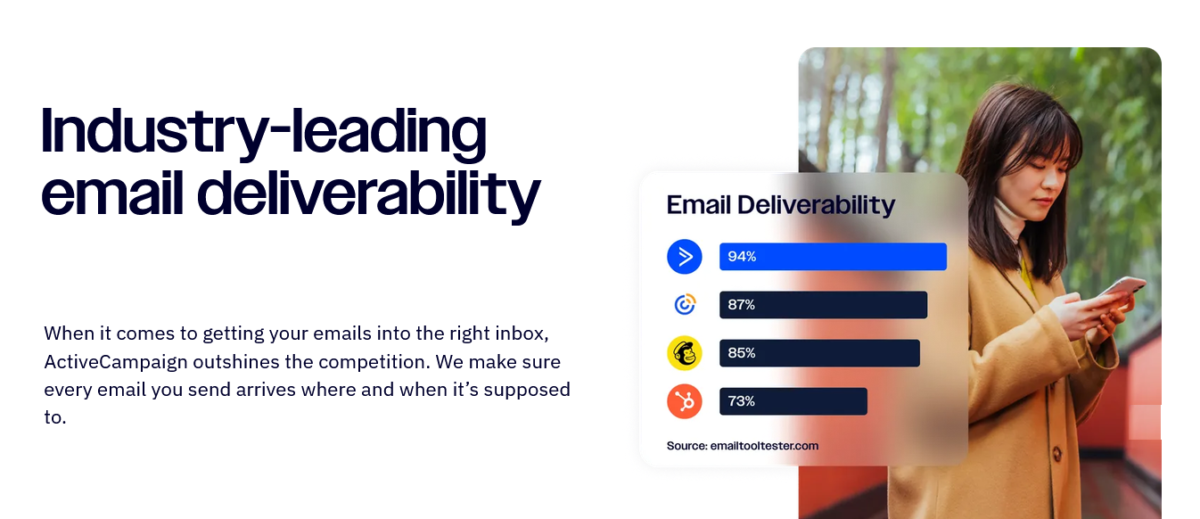
Deliverability is the metric that determines whether all your AI-crafted content actually reaches the inbox. And here the data is clear.
ActiveCampaign achieves 94%+ inbox placement rates across independent testing and provides built-in deliverability monitoring, DMARC analytics, reputation tracking, Feedback Loop (FBL) data, stricter list quality controls, and integration with list-cleaning services.
It generates 30% higher click-through rates (3.41% vs 2.62%) compared to Mailchimp, according to ActiveCampaign’s own February 2026 comparison data.
Mailchimp supports all standard authentication protocols (SPF, DKIM, DMARC) and has solid deliverability practices. However, independent comparison testing as of early 2026 puts ActiveCampaign ahead on overall deliverability feature completeness.
Mailchimp also has a notable billing quirk that affects list management: it counts unsubscribed and non-subscribed contacts toward your plan limit, meaning you pay for contacts who will never open your emails.
This can incentivize keeping inflated lists, which indirectly affects deliverability.
AI-powered Predictive Segmentation in Mailchimp (Standard+) does identify contacts most likely to purchase or engage, which helps with deliverability by keeping campaigns focused on engaged audiences. This is a genuine list intelligence tool.
| Feature | ActiveCampaign AI | Mailchimp AI |
|---|---|---|
| Deliverability Rate | 94%+ (independent testing) | Solid; slightly lower per 2026 data |
| DMARC + FBL monitoring | Yes | DMARC only |
| List cleaning integration | Yes | Manual |
| Predictive Segmentation (AI) | Yes (Plus+) | Yes (Standard+) |
| Billing for unsubscribed contacts | New accounts (Nov 2025+) | Yes (all plans) |
| Click-through rate vs competitor | 3.41% (AC) | 2.62% (MC) per AC data |
Winner: ActiveCampaign AI on deliverability infrastructure and inbox placement rates.
Try Active Intelligence today →
Round 6: Pricing and AI Feature Access
This is where the conversation gets complicated, and I want to be honest with you about both platforms.
ActiveCampaign Pricing 2026
Per user, per month, billed annually, 1,000 contacts:
| Plan | Price | Key AI Features Included |
|---|---|---|
| Starter | $15/mo | AI Brand Kit, AI-Suggested Segments (beta), Reporting Co-Pilot |
| Plus | $49/mo | Above + AI Campaign Builder, AI Content Generator |
| Pro | $79/mo | Above + AI Automations Agent, Predictive Sending, Performance Intelligence, AI Translations, full Active Intelligence |
| Enterprise | $145/mo | Above + custom objects, Salesforce integration, dedicated support |
The most powerful ActiveCampaign AI features require Pro at $79/month minimum. That’s the honest entry point for the full Active Intelligence experience.
Mailchimp Pricing 2026
Base price, 500 contacts:
| Plan | Price | Key AI Features Included |
|---|---|---|
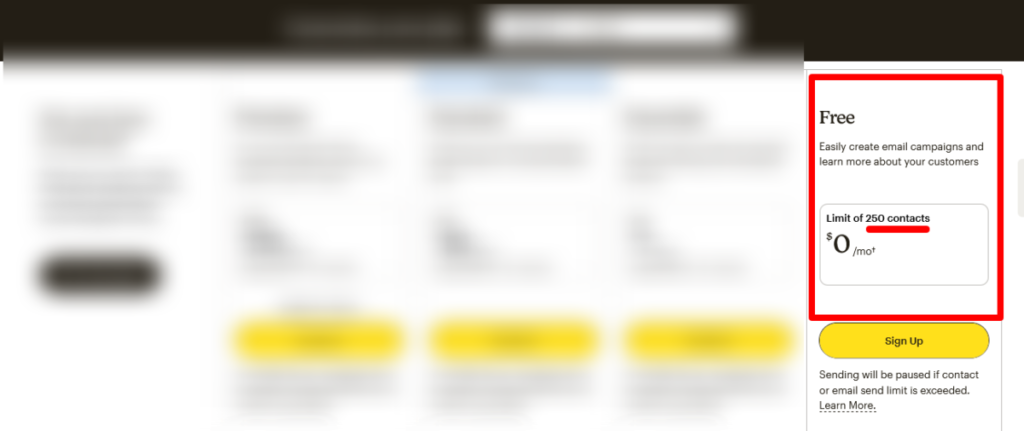
| Free | $0 | 250 contacts, 500 emails/month. No AI features (reduced Jan 2026) |
| Essentials | $13/mo | Basic automation only. No Intuit Assist AI features |
| Standard | $20/mo | Full Intuit Assist (Write with AI, Creative Assistant, Content Optimizer), send time optimization, predictive segmentation, Analytics AI (May 2026) |
| Premium | $350/mo | Same AI as Standard + advanced segmentation, phone support, priority access |
The meaningful Mailchimp AI experience starts at Standard ($20/month). That is significantly cheaper than ActiveCampaign Pro at $79/month.
However, pricing scales differently. At 5,000 contacts:
| Timeline | ActiveCampaign Pro | Mailchimp Standard |
|---|---|---|
| Monthly cost | $205/mo | $100/mo |
At 10,000 contacts:
| Timeline | ActiveCampaign Pro | Mailchimp Standard |
|---|---|---|
| Monthly cost | $375/mo | $135/mo |
Mailchimp is considerably cheaper at scale for comparable plan tiers. But two important caveats: first, Mailchimp’s Standard plan pricing is promotional for the first 12 months, after which costs effectively double across tiers. Second, Mailchimp charges for unsubscribed contacts, which inflates your effective contact count and therefore your bill.
Winner: Mailchimp on entry-level AI pricing. ActiveCampaign on what you actually get for the money at Pro tier.
👉 Get full ActiveCampaign AI on a 14-day trial.
Round 7: Ease of Use and AI Accessibility
Mailchimp was designed for accessibility first. The interface is clean, intuitive, and approachable for non-technical users. You can launch a campaign in under 30 minutes without reading a single tutorial.
The AI features on Standard are right there in the email builder, not buried in settings menus. Creative Assistant, Write with AI, Content Optimizer; all accessible without knowing what automation logic is.
ActiveCampaign is more powerful and more complex. Most users I’ve helped onboard needed 3 to 4 focused sessions before feeling comfortable navigating the platform confidently.
The AI reduces friction significantly; asking the Automations Agent to build a workflow is easier than building it manually, but you still need to understand what you’re asking for. Garbage in, garbage out applies even to very smart AI.
For teams that are new to marketing automation, Mailchimp’s AI is more immediately usable. For teams that know what they want to achieve and need the AI to execute with precision, ActiveCampaign’s AI is more capable.
Winner: Mailchimp on ease of access. ActiveCampaign on depth of what the AI can actually do once you know how to use it.
My Honest Summary
| Category | ActiveCampaign AI | Mailchimp AI | Winner |
|---|---|---|---|
| AI Campaign Building | ⭐⭐⭐⭐ | ⭐⭐⭐⭐ | Tie |
| AI Automation Building | ⭐⭐⭐⭐⭐ | ⭐⭐⭐ | ActiveCampaign |
| AI Send Time Optimization | ⭐⭐⭐⭐⭐ | ⭐⭐⭐⭐ | ActiveCampaign |
| AI Analytics + Performance | ⭐⭐⭐⭐⭐ | ⭐⭐⭐⭐⭐ | Tie (post May 2026) |
| AI Deliverability Intelligence | ⭐⭐⭐⭐⭐ | ⭐⭐⭐⭐ | ActiveCampaign |
| AI Pricing Accessibility | ⭐⭐⭐ | ⭐⭐⭐⭐⭐ | Mailchimp |
| AI Design + Creative Tools | ⭐⭐⭐ | ⭐⭐⭐⭐⭐ | Mailchimp |
| Ease of AI Use | ⭐⭐⭐ | ⭐⭐⭐⭐⭐ | Mailchimp |
| Autonomous AI Execution | ⭐⭐⭐⭐⭐ | ⭐⭐⭐ (coming) | ActiveCampaign |
| Claude Integration | ⭐⭐⭐⭐⭐ | ⭐⭐⭐⭐ | ActiveCampaign |
Who Should Choose Which Platform?
Choose ActiveCampaign AI if you:
- Need AI that executes marketing autonomously, not just assists you in creating
- Run complex, multi-step customer journeys with behavioral triggers and conditional logic
- Need per-contact send time optimization, not just audience-level timing
- Have a sales team and need marketing AI connected to a native CRM
- Are running multi-channel sequences across email, SMS, and WhatsApp
- Can invest in the Pro plan at $79/month and above, where the full AI capability lives
- Want sector benchmarking and proactive performance alerts from your AI
Choose Mailchimp AI if you:
- Are newer to email marketing and need AI that’s immediately accessible without a learning curve
- Need strong AI design and creative tools including visual brand consistency at scale
- Want solid AI analytics (especially post-May 2026 with Analytics AI) at a lower price point
- Run ecommerce primarily and want Shopify, WooCommerce, or Wix data connected natively to your analytics AI
- Have a tight budget and need meaningful AI features for $20/month on Standard
- Run primarily broadcast-style campaigns and newsletters rather than complex nurture sequences
Also Read: I Let ActiveCampaign AI Run My Marketing for 30 Days: Results
Final Ratings
ActiveCampaign AI: 8.7 / 10
| Category | Score |
|---|---|
| AI Automation (depth + autonomy) | 9.5/10 |
| Predictive Sending (per-contact) | 9.5/10 |
| AI Campaign Building | 8.5/10 |
| AI Performance Intelligence | 9/10 |
| Claude / MCP Integration | 9.5/10 |
| AI Design Tools | 7/10 |
| Pricing Accessibility | 7/10 |
| Ease of AI Use | 7.5/10 |
| Overall | 8.7/10 |
Mailchimp AI: 7.9 / 10
| Category | Score |
|---|---|
| AI Design + Creative Assistant | 9.5/10 |
| Analytics AI (May 2026) | 8.5/10 |
| AI Campaign Building | 8/10 |
| Send Time Optimization | 8/10 |
| AI Segment Builder | 7.5/10 |
| AI Automation (depth) | 6.5/10 |
| Pricing Accessibility | 9.5/10 |
| Ease of AI Use | 9.5/10 |
| Overall | 7.9/10 |
Conclusion
The ActiveCampaign AI vs Mailchimp AI comparison in 2026 is more competitive than it’s ever been. Mailchimp’s Analytics AI launch in May 2026 was a genuine leap forward, and the platform is no longer playing catch-up on analytics and data intelligence.
The Claude integration, the AI Segment Builder, the ecommerce data connections: these are real, meaningful features that close gaps that existed just six months ago.
But here is what I told Chidi. And I’ll tell you the same thing.
If your question is “which AI helps me create marketing faster?” Both platforms are genuinely strong. Mailchimp might actually be easier to start with.
If your question is “which AI executes my marketing strategy most autonomously?” ActiveCampaign is ahead.
The Automations Agent building full workflows from plain language, the per-contact predictive sending, the sector benchmarking, the 25+ specialized agents working together: that is a different level of autonomous capability than Mailchimp currently offers, even after the May 2026 updates.
The smarter marketing assistant depends entirely on what you need your marketing assistant to do.
Grow your business with AI-powered marketing →
Which platform are you leaning toward? Drop a comment. I read every single one, and I’ll tell you exactly what I think based on what you’ve shared.
FAQs
What is the difference between ActiveCampaign AI and Mailchimp AI?
ActiveCampaign AI is powered by Active Intelligence, a system of 25+ specialized AI agents that autonomously build campaigns, construct multi-step automation workflows, optimize send times per individual contact, benchmark performance against sector data, and execute marketing strategy from plain-language goals.
Mailchimp AI is powered by Intuit Assist, which includes generative content creation (Write with AI), design automation (Creative Assistant), content quality analysis (Content Optimizer), send time optimization, predictive segmentation, and, as of May 2026, Analytics AI — a conversational analytics agent that connects campaign performance, audience behavior, and revenue data in plain-language responses.
ActiveCampaign AI is stronger on autonomous execution. Mailchimp AI is stronger on design, creative assistance, and accessibility.
Is ActiveCampaign AI available on all plans?
Partially. Core features like the AI Brand Kit, AI-Suggested Segments (beta), and the Campaign Reporting Co-Pilot are available on all plans.
The most powerful features, including the AI Automations Agent, Predictive Sending (per-contact), AI Performance Intelligence, and AI Translations, require the Pro plan at $79/month (1,000 contacts, annual billing) or above.
Is Mailchimp AI available on all plans?
No. As of January 2026, Intuit Assist AI features (Write with AI, Creative Assistant, Content Optimizer, send time optimization, predictive segmentation) are available on the Standard plan ($20/month for 500 contacts) and Premium plan ($350/month) only.
The Free plan (limited to 250 contacts and 500 emails per month as of January 2026) and Essentials plan ($13/month) do not include Intuit Assist AI features. Analytics AI, launched May 2026, is available on paid plans.
Intuit Assist availability is primarily US-based with international rollout ongoing.
What is Mailchimp Analytics AI?
Analytics AI is a native conversational analytics agent launched by Mailchimp on May 28, 2026. It connects performance data across campaigns, audiences, and revenue and allows marketers to ask plain-language questions and receive instant, strategic recommendations without building dashboards or exporting reports.
It uses connected ecommerce data from Shopify, WooCommerce, and Wix alongside Mailchimp campaign history to identify patterns and surface revenue opportunities.
Mailchimp describes it as the foundation for a fully agentic marketing experience where AI plans strategy, builds audiences, and drafts campaigns based on business goals.
Does Mailchimp have an AI automation builder?
Not yet in the same sense as ActiveCampaign. Mailchimp’s Customer Journey Builder (Standard+) allows multi-step automation with branching logic up to 200 journey points, and AI can generate fully built emails for each automation step.
However, there is no equivalent to ActiveCampaign’s AI Automations Agent, which constructs complete multi-step workflows autonomously from a plain-language description.
Mailchimp’s May 2026 announcement indicates fully agentic automation capability is on the roadmap but described as “coming soon.”
Which has better email deliverability, ActiveCampaign or Mailchimp?
According to independent comparison testing and ActiveCampaign’s own February 2026 data, ActiveCampaign achieves 94%+ inbox placement rates and generates 30% higher click-through rates (3.41% vs 2.62%) compared to Mailchimp.
ActiveCampaign also provides more comprehensive deliverability infrastructure, including DMARC analytics, Feedback Loop data, reputation tracking, and list-cleaning integrations. Both platforms support standard authentication protocols.
Both platforms charge for unsubscribed contacts (Mailchimp across all plans; ActiveCampaign for accounts created after November 2025), which can inflate contact counts and requires active list hygiene practices.
Which is cheaper, ActiveCampaign AI or Mailchimp AI?
Mailchimp is significantly cheaper for full AI access. Meaningful Mailchimp AI (Intuit Assist) starts on the Standard plan at $20/month for 500 contacts (promotional first-year pricing; costs effectively double after 12 months).
Full ActiveCampaign AI (Active Intelligence with Automations Agent, Predictive Sending, Performance Intelligence) requires the Pro plan at $79/month for 1,000 contacts (annual billing).
At 5,000 contacts, Mailchimp Standard costs approximately $100/month versus ActiveCampaign Pro at $205/month.
However, per-contact pricing on Mailchimp applies to unsubscribed contacts, which can raise actual costs beyond listed prices.
Can both ActiveCampaign and Mailchimp connect to Claude AI?
Yes, both now integrate with Claude. ActiveCampaign launched its native MCP Server connector in November 2025, becoming the first autonomous marketing connector in Anthropic’s Claude Connector Directory.
Through this, users can retrieve campaign data, build campaigns, manage contacts, and trigger automations via natural language inside Claude.
Mailchimp announced its own Claude integration in May 2026 as part of its Analytics AI launch, allowing Mailchimp users to access marketing data and analytics conversationally inside Claude. Both integrations require a paid Claude plan.
Which platform is better for ecommerce AI marketing?
Both are strong for ecommerce, with different strengths.
ActiveCampaign excels at behavior-triggered automation sequences such as abandoned cart recovery, post-purchase upsells, and win-back campaigns, with deep Shopify and WooCommerce integrations and per-contact predictive sending.
Mailchimp’s May 2026 Analytics AI launch strengthened its ecommerce position significantly by connecting Shopify, WooCommerce, and Wix transaction data directly to campaign analytics and AI recommendations.
Mailchimp also reported that ecommerce customers connected with Shopify see up to $41 return for every dollar spent. For complex behavioral ecommerce automation, ActiveCampaign is stronger.
For accessible ecommerce AI analytics and simpler automated flows, Mailchimp competes seriously in 2026.
Should I switch from Mailchimp to ActiveCampaign for the AI features?
It depends on your use case. Switch to ActiveCampaign if you need autonomous AI that builds and runs complex multi-step automation workflows, per-contact send time optimization, AI-powered lead scoring, CRM-connected marketing, and sector benchmarking.
Stay with Mailchimp if your campaigns are primarily newsletters and simple sequences, you value design AI and Creative Assistant tools, budget is a priority, or you want to benefit from Mailchimp’s new Analytics AI at $20/month on Standard.
The May 2026 Analytics AI launch makes Mailchimp significantly more competitive than it was 12 months ago, especially for businesses where data analysis was the main gap.
- WordPress.com AI Review 2026: I Built A Site In Minutes – Mythemetool
- Printify Vs Printful Vs Gelato 2026: My Honest Comparison – Mythemetool
- Kit Vs Mailchimp 2026: Why I Finally Ditched The Chimp – Mythemetool
- Make.com Review 2026: I Saved $720/Year Ditching Zapier – Mythemetool
- Proton Pass Review 2026: Is This $1.99 Manager Worth It? 🔑 – Mythemetool
Related articles:

Active Intelligence 3.0: Wavelength Review: Whats New? – Mythemetool

Onepage Review 2026: I Built 5 Pages To See If Its Worth It – Mythemetool

Ultahost Review 2026: I Read 20+ Reviews First (My Findings) – Mythemetool

Levamo Review 2026: Blazing-Fast Hosting Or Overpriced? – Mythemetool

Rocon WordPress Hosting Review 2026: Fast, Secure, But Is It Worth It? – Mythemetool

Printify Vs Printful Vs Gelato 2026: My Honest Comparison – Mythemetool

Bluehost AI All-Access Pack Review 2026: Is It Worth It? – Mythemetool

B2BKing WooCommerce Plugin Review 2026: Is It Worth It? – Mythemetool

WordPress.com Vs WordPress.org: My Recommendation After Using Both In 2026 – Mythemetool

SignalHire Review 2026: Is This Contact Finder Worth Your Money? – Mythemetool

Kit Vs Mailchimp 2026: Why I Finally Ditched The Chimp – Mythemetool

Make.com Review 2026: I Saved $720/Year Ditching Zapier – Mythemetool
Zapier Vs Make.com 2026: I Tested Both And Got Surprised – Mythemetool

WordPress.com AI Review 2026: I Built A Site In Minutes – Mythemetool

Proton VPN Review 2026: Is This Swiss VPN Worth The Hype? – Mythemetool

Proton Mail Review 2026: Is Swiss Privacy Worth It? 🔐 – Mythemetool